
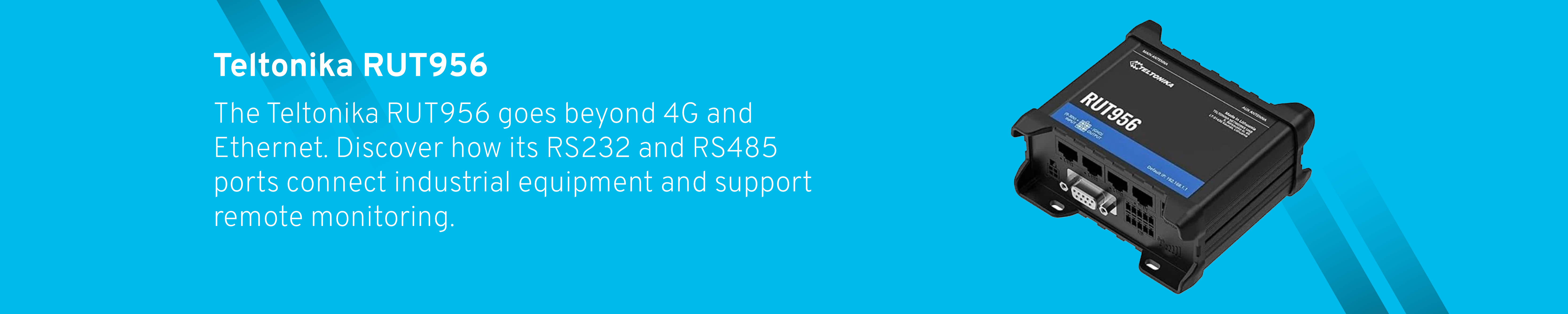
At first glance, the Teltonika RUT956 Industrial 4G LTE router looks like a fairly conventional industrial 4G router. It has four Ethernet ports, Wi-Fi, dual-SIM connectivity and the networking features you'd expect from a router designed for demanding environments.
But look beyond the Ethernet connections and you'll find two interfaces that make the RUT956 particularly interesting: RS232 and RS485 serial communication ports.
These serial communication interfaces open up applications that go well beyond connecting computers, switches and other IP-enabled devices. They allow the RUT956 to communicate with industrial equipment such as power systems, controllers, energy meters and monitoring devices that may not have Ethernet connectivity.
For organisations operating remote infrastructure, that capability can make the difference between simply having a site connected to the Internet and being able to access the equipment keeping it operational.
There's More to Industrial Networking Than Ethernet
Ethernet has become fundamental to modern networking, but it isn't the only communication technology keeping critical infrastructure running.
Consider a telecommunications site. Its routers and switches may be accessible over IP, but the generator, battery system, UPS and other supporting equipment could be communicating through entirely different interfaces.
The same situation exists in manufacturing plants, water treatment facilities and power installations, where equipment from different manufacturers and generations must operate together.
RS232 and RS485 remain widely used in these environments. RS485, in particular, is well suited to applications requiring longer cable runs and reliable communication amid electrical interference.
Replacing otherwise functional equipment simply to obtain Ethernet connectivity isn't always practical or economically justified. Neither is installing a separate communications gateway for every serial-connected device.
By incorporating RS232 and RS485 alongside conventional Ethernet and cellular interfaces, the RUT956 gives network operators and systems integrators more flexibility when connecting existing industrial equipment.
RS232: Bringing Remote Equipment Management Within Reach
The RUT956 features a DB9 RS232 port, providing a direct serial communication interface for compatible equipment.
RS232 is commonly found on UPS systems, industrial controllers, legacy equipment and network devices that expose serial management or console interfaces.
Its usefulness becomes particularly apparent when equipment is installed at a remote location.
Imagine an ISP operating network infrastructure at a site several hours away from its technical team. The site has a router or another managed device with a serial console interface, but its primary network connection has become unavailable.
Ordinarily, restoring access might require a technician to visit the installation, connect a laptop to the console port and investigate the fault locally.
With the RUT956 connected to a compatible serial console and configured for secure remote access, an engineer can potentially reach that interface through the router's independent cellular connection. That could allow the engineer to inspect system messages, investigate configuration problems or perform supported recovery operations without immediately travelling to the site.
The RUT956 supports serial-over-IP communication, enabling serial data to be exchanged over TCP/IP networks. Its VPN capabilities can help secure access to these services.
The same principle extends to compatible industrial controllers and UPS management interfaces, although successful connections depend on the equipment's electrical interface, cabling and communication settings.
RS485: Keeping an Eye on More Than One Device
While RS232 is commonly used for direct communication with an individual device, RS485 is particularly useful where multiple pieces of industrial equipment need to communicate across a site.
The RUT956 features a six-pin RS485 interface supporting both two-wire half-duplex and four-wire full-duplex communication.
RS485 is widely used in energy management, industrial automation and instrumentation, where electricity meters, generator controllers, PLCs and sensors may be distributed throughout a facility.
Its ability to support multidrop communication means several compatible devices can share a properly designed communication bus.
Consider a commercial or industrial installation with multiple electricity meters monitoring different sections of a facility. Rather than requiring an individual Ethernet connection for every meter, compatible RS485 meters can communicate over a shared serial network connected to the RUT956.
Using a protocol such as Modbus RTU, the router can retrieve available measurements from the connected devices. Depending on the meters and their supported registers, this might include voltage, current, power consumption and other electrical parameters.
That information can then be forwarded to a suitable monitoring platform, giving facility managers or maintenance teams visibility into equipment performance and energy usage.
A similar arrangement could be used for compatible generator controllers, pumping systems or industrial instrumentation.
Turning Serial Communications into Useful Information
The RUT956's ability to physically connect to serial equipment is only part of its appeal.
Through Teltonika's RutOS operating system, the router supports functions that allow compatible serial devices to communicate with applications operating on IP networks.
For example, its Modbus TCP-to-RTU gateway functionality allows a Modbus TCP client to exchange information with compatible equipment connected through RS232 or RS485. This is particularly useful where an organisation already has a monitoring application that communicates over IP but needs to retrieve information from serial-connected equipment.
For centralized data collection, RutOS also supports forwarding collected information using protocols such as MQTT and HTTP(S), allowing operational information to reach monitoring dashboards and other applications without necessarily replacing existing field equipment.
However, the router doesn't automatically interpret every device connected to its serial ports. Supported protocols, device settings and data registers must be configured appropriately, while the monitoring platform determines how the collected information is displayed and used.

Built for More Than Serial Connectivity
The RUT956's serial interfaces are supported by other industrial features that extend its usefulness in remote installations. Its digital and analog input/output (I/O) capabilities allow compatible sensors, alarm contacts and control circuits to be incorporated into the installation.
For example, a cabinet door contact can be connected to a suitable digital input. When the contact changes state, the router can trigger a configured notification, alerting maintenance or security personnel to the event.
The router also supports 4G LTE Cat 4 connectivity, with two physical SIM slots that enable automatic switching between mobile operators under configured conditions.
Ethernet WAN failover provides another connectivity option, while VPN support and Teltonika's Remote Management System (RMS) enable secure remote access and centralized router administration.
Combined with its rugged industrial construction and wide operating temperature range, these features make the RUT956 suitable for appropriately protected installations across telecommunications, utilities and industrial environments.
Where the RUT956 Earns Its Place
Not every installation requires RS232, RS485 or industrial I/O. If the objective is simply to provide cellular connectivity to an Ethernet-enabled device, a more basic industrial router may be sufficient.
The RUT956 becomes particularly relevant when an installation involves equipment with different communication interfaces.
An ISP might use its RS232 port to establish an independent management connection to a compatible network device. An energy management integrator could use RS485 to collect readings from multiple meters. A utility operator might combine serial communications with equipment alarm monitoring at a remote site.
For organisations with existing industrial infrastructure, these capabilities offer opportunities to improve remote access and monitoring while retaining functional equipment.
The RUT956's Ethernet ports and LTE connectivity are useful, but its RS232 and RS485 interfaces considerably expand what the router can connect and the applications it can support.
Before investing in additional gateways or replacing equipment simply to make it network-accessible, consider what the Teltonika RUT956 can already connect.
Explore the RUT956 with Optace Networks and discover how its industrial connectivity capabilities can fit into your next deployment
Latest Articles
Thu Nov 12 2026
High-Speed Ports Don't Guarantee High-Speed Routing: Understanding L3 Hardware OffloadingThu Oct 29 2026
MikroTik Is Making 100G Networking Harder to IgnoreWed Oct 14 2026
Netgate 8300 for High-Capacity Firewall and VPN DeploymentsFri Sep 18 2026
How to Size a Netgate Firewall for Your Business NetworkRelated Articles

ePMP 3000 - 5X Performance with Gen3 Technology

Africa Tech Festival Displays Strides in Connectivity and Telecommunications Infrastructure across Africa

Cambium Networks ePMP Force 425 - The Industry’s First Point-to-Point Solution Based on 802.11ax
The Power of OFDMA in Wireless Broadband
In this article, we delve into the principles of OFDMA, the defining principle of the 802.11ax standard, its applications, and its impact on wireless broadband.



© 2026 PoweredbyOptace Networks Limited. All Rights Reserved.