
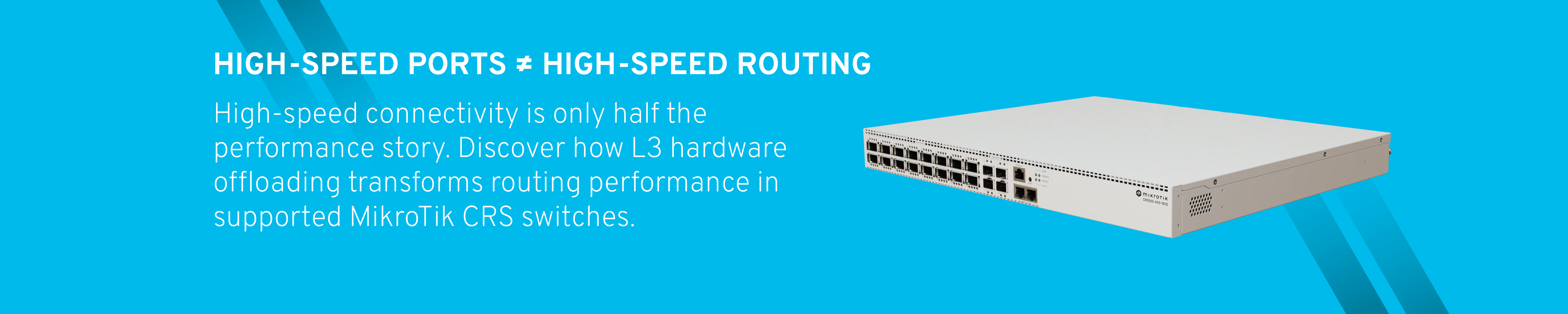
When evaluating a network switch, port speed is usually one of the first specifications buyers consider. A MikroTik Cloud Router Switch (CRS) offering 10G, 25G or 100G connectivity promises substantial bandwidth, but there's an important distinction that can easily be overlooked.
A switch capable of forwarding traffic at 100Gbps isn't necessarily capable of routing traffic at the same speed.
For businesses, ISPs and data centre operators deploying MikroTik CRS switches, understanding the difference between switching capacity and routing performance is essential, particularly when traffic needs to move between VLANs or different IP networks. For businesses, ISPs and data centre operators deploying MikroTik CRS switches, the distinction between switching capacity and routing performance matters whenever traffic moves between VLANs or different IP networks. Layer 3 hardware offloading (L3HW) plays a crucial role in determining how efficiently supported switches handle that traffic.
Switching Capacity vs Routing Performance
MikroTik CRS switches use dedicated switching chips to forward traffic efficiently between connected devices. Within the same VLAN, packets can move through the switching hardware without requiring CPU processing.
Routing traffic between different IP subnets introduces additional processing. Without hardware acceleration, this work falls to the switch's CPU, which can become a bottleneck even when the physical interfaces have substantial unused capacity.
Layer 3 Hardware Offloading (L3HW) addresses this limitation by allowing supported MikroTik CRS switches to perform IP routing directly through their switching ASICs. RouterOS maintains the routing information and programs eligible forwarding entries into the hardware. The switch chip then handles the corresponding traffic without requiring the CPU to process every packet.
This capability isn't unique to MikroTik. Hardware-based Layer 3 forwarding is well established in enterprise networking. What matters is how effectively a particular CRS model implements it and which routing functions its switch chip supports.
What MikroTik's Performance Tests Reveal
MikroTik's published benchmarks demonstrate how significantly routing throughput can change depending on whether traffic is processed by the CPU or offloaded to hardware.
Take the CRS310-8G+2S+IN, which combines eight 2.5GbE ports with two 10G SFP+ interfaces.
In MikroTik's tests using 1,518-byte frames, the switch achieved approximately:
- 1.27Gbps aggregate routing throughput using CPU-based FastPath.
- 38.27Gbps aggregate routing throughput with L3 hardware offloading.
The difference becomes even more pronounced on larger platforms.
The CRS520-4XS-16XQ-RM, equipped with sixteen 100G QSFP28 ports and four 25G SFP28 ports, recorded approximately 35.95Gbps in CPU-based FastPath routing tests, compared with 1.676Tbps using L3 hardware offloading.
These manufacturer benchmarks measure aggregate throughput across the tested interfaces under specific conditions. They aren't guaranteed production speeds. Packet size, configuration, and enabled networking features can all influence actual performance.
Nevertheless, they illustrate an important point: the speed of a network interface and the device's ability to route traffic through it are two different performance considerations. When comparing MikroTik CRS switches, businesses should therefore consider both switching capacity and hardware-accelerated routing performance under workloads that resemble their actual network traffic.
L3 Hardware Offloading: Support and Limitations
L3 hardware offloading is supported across several MikroTik CRS families, including models such as the CRS310, CRS317, CRS510 and CRS520.
However, support doesn't mean identical capabilities.
Different switch chips have different hardware forwarding capacities and feature sets. The number of routes that can be stored in hardware varies, as does support for features such as FastTrack and NAT offloading.
This becomes particularly relevant in ISP networks using dynamic routing protocols such as BGP. Although RouterOS can maintain extensive routing tables, a switch's hardware may not have sufficient capacity to offload every route. Entries that cannot be accommodated in hardware may require CPU forwarding.
Firewall processing is another important consideration.
Traffic routed entirely through the switch ASIC bypasses the normal CPU-based RouterOS IP firewall. While supported hardware can enforce certain access-control rules and accelerate eligible FastTrack connections, hardware routing doesn't provide unrestricted acceleration for every firewall or traffic-management function.
Configuration also matters. L3 hardware offloading depends on compatible Layer 2 hardware forwarding and appropriately configured interfaces and VLANs. Simply enabling the feature doesn't guarantee that all routing traffic will be offloaded.
These limitations make it important to evaluate the switch chip and its supported functions alongside the device's advertised switching capacity.

Choosing the Right MikroTik CRS for Your Network
For enterprise networks, L3 hardware offloading can make CRS switches effective at handling high-volume inter-VLAN traffic without unnecessarily burdening a central router.
ISPs can use supported models for high-speed Layer 3 aggregation, provided their routing requirements fit within the hardware's forwarding capabilities. Data centre environments can similarly benefit from routing suitable traffic directly through high-capacity switching infrastructure.
However, workloads requiring extensive stateful firewall inspection, complex traffic management or other CPU-intensive services may be better handled by dedicated routing platforms.
In MikroTik environments, this can mean combining CRS switches for high-speed switching and hardware-assisted routing with Cloud Core Routers (CCR) for more demanding routing and security functions.
The objective isn't to offload every routing task to a switch, but to deploy each device where its architecture delivers the greatest value.
High-speed interfaces are only part of the performance equation. Understanding how a CRS switch handles Layer 3 traffic is equally important when selecting equipment for a growing network.
Before purchasing a MikroTik CRS switch, assess the required routing throughput, hardware route capacity, supported offloading features and security requirements to determine whether the model fits your network architecture.
At Optace Networks, we help businesses, ISPs and enterprise customers identify MikroTik switching and routing solutions suited to their network requirements. Contact us for guidance on selecting the right CRS model and to request a competitive quotation
Latest Articles
Thu Nov 12 2026
High-Speed Ports Don't Guarantee High-Speed Routing: Understanding L3 Hardware OffloadingThu Oct 29 2026
MikroTik Is Making 100G Networking Harder to IgnoreWed Oct 14 2026
Netgate 8300 for High-Capacity Firewall and VPN DeploymentsFri Sep 18 2026
How to Size a Netgate Firewall for Your Business NetworkWed Sep 09 2026
Planning Internet Failover with Netgate and pfSense PlusRelated Articles

ePMP 3000 - 5X Performance with Gen3 Technology

Africa Tech Festival Displays Strides in Connectivity and Telecommunications Infrastructure across Africa

Cambium Networks ePMP Force 425 - The Industry’s First Point-to-Point Solution Based on 802.11ax
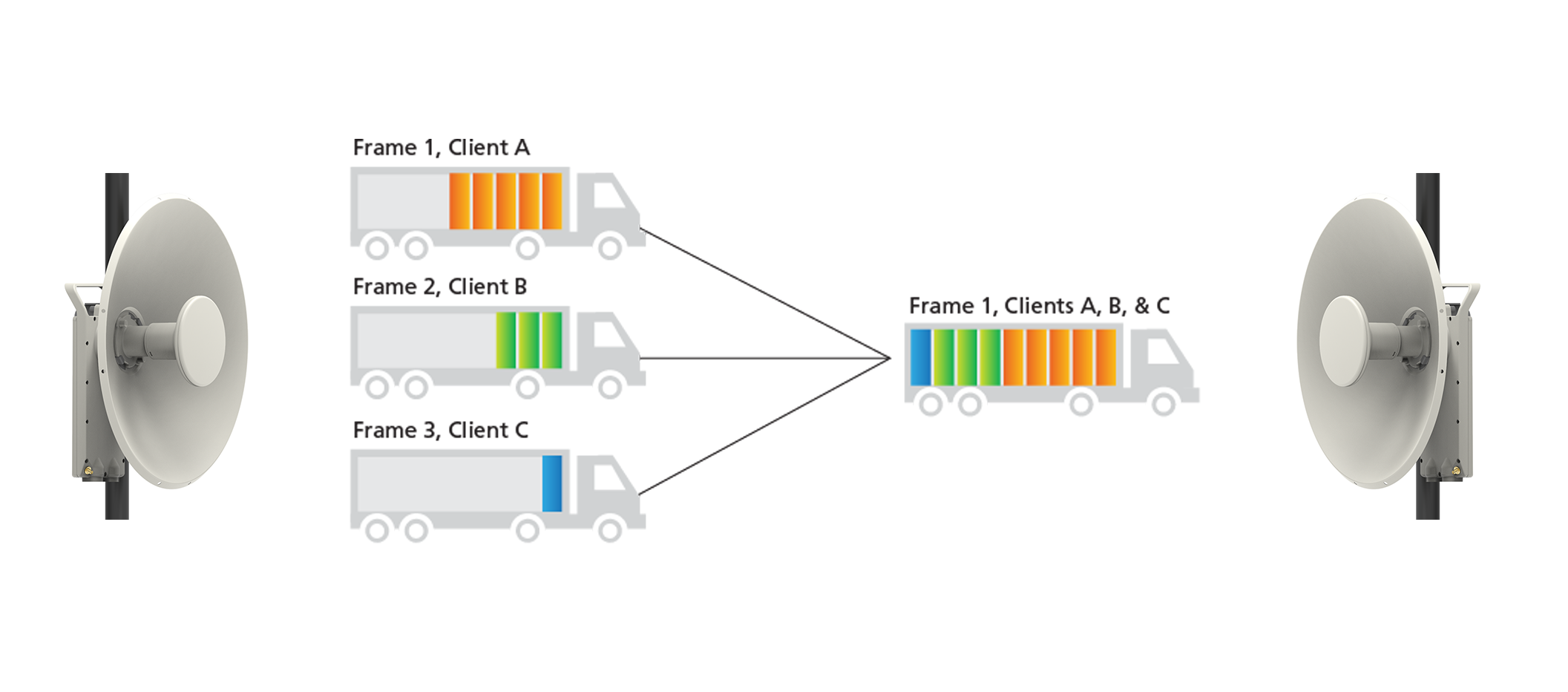
The Power of OFDMA in Wireless Broadband
In this article, we delve into the principles of OFDMA, the defining principle of the 802.11ax standard, its applications, and its impact on wireless broadband.



© 2026 PoweredbyOptace Networks Limited. All Rights Reserved.