
Remote surveillance and IoT sites are becoming less like isolated endpoints and more like small network nodes. A surveillance installation may combine an IP camera with its backhaul equipment, while an IoT site may use an edge gateway to aggregate field data before handing it into the wider network.
The challenge is that these increasingly capable sites are often deployed exactly where conventional power is difficult to provide.
That changes how the power layer should be considered. It is no longer enough to ask whether a remote power system can keep the endpoint running. Network teams also need to consider how the power platform fits into the site topology and what happens when conditions at an unattended location deteriorate.
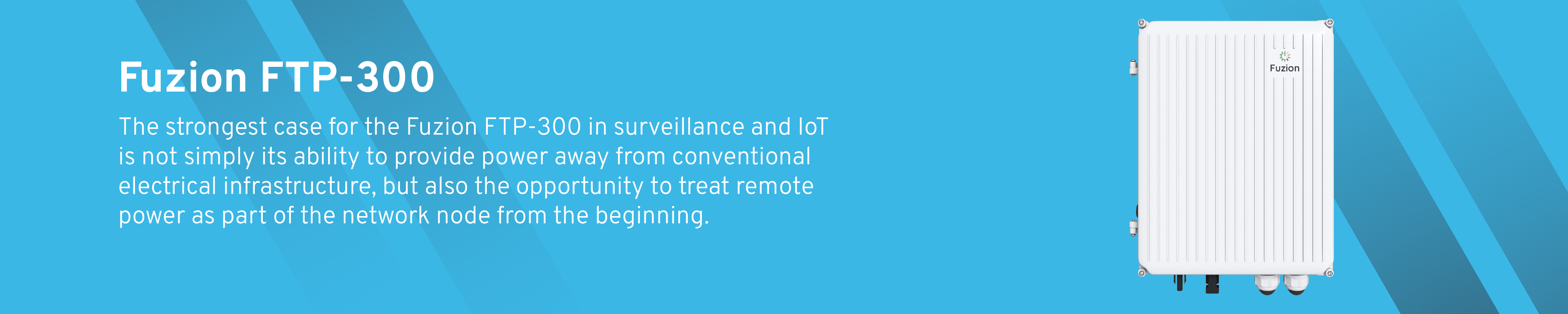
The Fuzion FTP-300 is designed around that broader requirement. It provides remote network power in an outdoor platform with Gigabit connectivity, allowing it to sit directly within modern surveillance and IoT architectures rather than being treated as a separate utility system around them.
Treat the Remote Site as a Network Node
The useful unit of design is often the site rather than the individual device.
In a remote surveillance deployment, the FTP-300 can power the camera alongside the radio carrying its traffic back into the network. Data can pass through the same platform, reducing the amount of separate PoE hardware required at the site and simplifying the field installation.
The important point is architecture. The camera and its backhaul can be treated as one powered network node rather than as separate devices that each require their own supporting infrastructure.
This becomes increasingly valuable as the deployment expands. A repeatable node is easier to document and troubleshoot, while technicians encounter a more familiar site architecture across the network.
The same principle applies to IoT. A gateway may sit between field devices and the wider IP network, making the remote location an active part of the network rather than simply a collection point for sensor data.
Once the site performs that role, its power system becomes part of the network architecture and should be engineered with the same attention given to the connectivity it supports.
Design for Network Headroom, Not Just Today's Traffic
Gigabit connectivity at a remote site should not be interpreted as a claim that every connected camera or IoT gateway will generate anything close to 1Gbps.
The more useful consideration is headroom.
Video traffic can vary significantly according to resolution and scene activity. Remote viewing may also change the traffic profile when operators pull additional streams from a camera during an investigation.
Designing the supporting infrastructure too closely around an observed average can therefore leave less room for traffic peaks or later changes in the surveillance system.
The Fuzion FTP-300's Gigabit connectivity gives the network path sufficient headroom to sit comfortably within these architectures without making the power platform a limiting factor in future capacity decisions.
That becomes particularly relevant when the endpoint changes before the supporting infrastructure does. A camera may be replaced with a higher-resolution model years after the site was first commissioned, while the power installation remains perfectly serviceable.
A remote site is easier to evolve when each infrastructure layer has enough capacity to survive those refresh cycles.
Edge Computing Changes the IoT Site
The same principle applies differently to IoT.
Many sensors generate very little network traffic. The more significant change is taking place at the gateway, where increasingly capable devices can aggregate information from multiple field systems and perform more processing locally.
Instead of simply forwarding telemetry upstream, the gateway can become an edge-compute point with greater responsibility within the application architecture. Over time, more capable hardware may be introduced at the same location as the underlying IoT deployment develops.
The network serving that site may evolve as well.
For network teams, the useful question is therefore not whether today's sensor workload requires Gigabit connectivity. It is whether the supporting infrastructure leaves enough room for the site to become more capable without forcing an unnecessary redesign.
The FTP-300 allows the power platform to remain useful while those application-layer decisions evolve around it.
Remote-Site Availability Is More Than Battery Runtime
Battery autonomy is an obvious consideration in an off-grid deployment, but runtime alone does not determine whether the network is resilient. Failure behaviour matters too.
If available energy drops below the level required to sustain the connected equipment, the FTP-300 can protect the battery by shutting down its outputs. Once sufficient charging energy becomes available again, the system can restore operation automatically.
For an unattended site, that recovery behaviour has practical operational value.
A power system may survive an extended low-energy condition perfectly well, yet the network can remain unavailable if somebody still has to travel to the location to bring equipment back online.
The ability to recover without manual intervention removes that particular dependency from the site.
Remote power visibility adds another useful layer to operations. When a site drops offline, network teams need to determine whether they are looking at a connectivity problem or a power-side event before dispatching field personnel.
The more information available remotely, the better that first diagnosis can be.
This is why remote power infrastructure should be evaluated on more than stored energy. Network professionals should also consider how the site fails and how it returns to service.
_1787919406.png)
Standardisation Changes the Economics at Scale
Almost any competent engineering team can build a custom solar-powered camera site. The more difficult question is what happens when the same organisation has to operate dozens of them.
Minor variations introduced during successive installations can gradually create an inconsistent field estate. A technician arriving at one location may find a different power arrangement from the previous site, even though both installations perform the same function. That affects troubleshooting and increases the amount of site-specific knowledge the support team has to maintain.
The FTP-300 provides an opportunity to standardise the underlying remote power architecture while allowing the endpoint equipment to vary according to the application.
A surveillance node can use the same platform as an IoT site where the electrical requirements are compatible. The network equipment connected to it can differ, but the field architecture remains familiar.
For larger deployments, that repeatability can be more valuable than optimising every site independently. It simplifies deployment planning and gives operations teams a more predictable environment when something eventually goes wrong.
Keep the Power Layer Relevant Through the Device Lifecycle
Remote power infrastructure will often remain in place longer than the equipment it initially supports. A surveillance camera may be replaced several times during the life of the site. An IoT gateway may also be upgraded as the application becomes more capable. Those refreshes should not automatically force changes further down the infrastructure stack.
With Gigabit connectivity built into the FTP-300, the power platform has enough network headroom to remain relevant as the endpoint equipment evolves. The operator can change what the site does without unnecessarily changing how the site is powered.
That is an important distinction in lifecycle planning.
Infrastructure should be replaced because its own requirement has changed, not simply because another component in the architecture has moved forward.
Design the Power Layer as Part of the Network
The strongest case for the Fuzion FTP-300 in surveillance and IoT is not simply its ability to provide power away from conventional electrical infrastructure, but also the opportunity to treat remote power as part of the network node from the beginning.
The FTP-300 can support the endpoint and its network path within a repeatable outdoor architecture. Its Gigabit connectivity provides the headroom expected around modern edge equipment, while autonomous recovery helps the site return to service after adverse power conditions without unnecessary field intervention.
For network decision-makers, that makes the conversation about more than powering a camera or gateway. It becomes a question of how the remote site will behave throughout its operational life.
Optace Networks brings Fuzion distribution together with the network engineering expertise to design FTP-300 deployments around the wider surveillance or IoT architecture. If you are planning remote surveillance or IoT sites, talk to our team about building a deployment that is easier to operate today and ready for the network requirements that come next.
Latest Articles
Fri Sep 18 2026
How to Size a Netgate Firewall for Your Business NetworkWed Sep 09 2026
Planning Internet Failover with Netgate and pfSense PlusFri Aug 28 2026
Fuzion FTP-300 for Outdoor IoT and Surveillance NetworksRelated Articles
.jpg)
ePMP 3000 - 5X Performance with Gen3 Technology
-(1).png)
Africa Tech Festival Displays Strides in Connectivity and Telecommunications Infrastructure across Africa

Cambium Networks ePMP Force 425 - The Industry’s First Point-to-Point Solution Based on 802.11ax
The Power of OFDMA in Wireless Broadband
In this article, we delve into the principles of OFDMA, the defining principle of the 802.11ax standard, its applications, and its impact on wireless broadband.



© 2026 PoweredbyOptace Networks Limited. All Rights Reserved.